


Everything you need to know about enhancing property value in Italy: from economic benefits to renovation techniques for the Mediterranean climate.
Table of Contents
What is an Energy Class and how does it work?
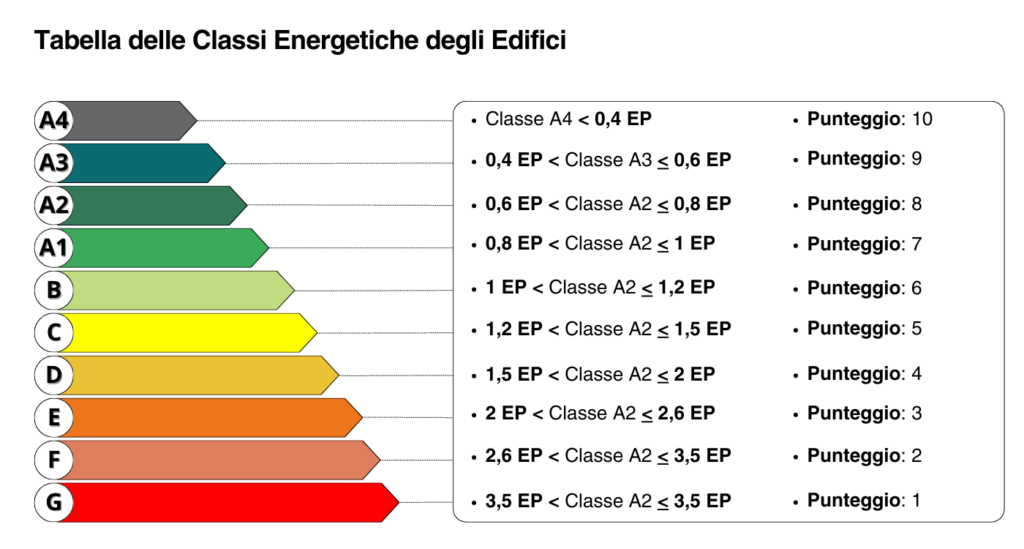
In Italy, a building’s energy class is a summary indicator of its energy consumption.
The scale ranges from A4 (the most efficient) down to G (the least efficient).
This rating doesn’t just measure “carbon footprint”; it directly correlates to how much money you will spend to keep your home comfortable.
The calculation is based on the global non-renewable energy performance index (EPgl,nren).
Essentially, the less energy a building requires for heating, cooling, hot water, and lighting, the higher its class.
In a region like Lecce, where summer temperatures frequently soar above 40°C, a high energy class is a game-changer for daily comfort and overhead costs.
Who certifies and how: The APE Certificate
The official document used to declare a building’s efficiency is the APE (Attestato di Prestazione Energetica). If you are buying, selling, or renting a home in Puglia, this document is mandatory.
- The Certified Energy Auditor: Only qualified professionals (architects, engineers, or “geometri”) registered with the professional board can issue an APE. They must be an independent third party.
- The Procedure: The technician must perform an on-site inspection. They analyze the thermal insulation of walls, the quality of windows/fixtures, the heating and cooling systems, and any renewable energy sources like solar or photovoltaic panels.
- Validity: An APE is generally valid for 10 years, provided that regular maintenance is performed on the thermal systems. If you carry out major renovations, a new certificate must be issued.
The Lecce Case: Energy efficiency vs. Salento heat
Renovating a property in Lecce, Gallipoli, or Otranto presents challenges that differ from Northern Europe. Here, the primary enemy isn’t just the damp winter—it’s the extreme summer heat.
Many historic homes in the Salento area are built with Lecce Stone (Pietra Leccese) or Carparo. These materials have incredible thermal inertia; they breathe well but can also store heat during the day and release it at night. Improving an energy class in Puglia means balancing the preservation of this stone with modern insulation techniques to prevent the building from becoming a “heat trap.”
Practical steps to upgrade your energy class
Moving from a Class G to a Class B or A requires an integrated approach. Design Danieli specializes in several key interventions specifically adapted for the Puglia region:
- Thermal Insulation (External or Internal Coating): Applying insulating panels to walls significantly reduces heat exchange. In Salento, we use breathable materials to prevent humidity and mold issues common in historic masonry.
- High-Performance Windows: Replacing old fixtures with thermal-break windows and low-emissivity double or triple glazing stops heat from entering in July and escaping in January.
- Heat Pumps & Hybrid Systems: Swapping old gas boilers for modern electric heat pumps, often paired with underfloor heating/cooling systems.
- Solar Photovoltaic Systems: With more than 300 days of sunshine a year, Lecce is the perfect location for solar power. This allows for near-zero cooling costs during the summer.
- VMC (Mechanical Ventilation): Ensuring air changes without losing energy, vital for buildings that have been highly insulated.
The Pros and Cons of a high energy rating
The Benefits
- Lower Utility Bills: A Class A home can reduce energy costs by up to 80% compared to Class G.
- Enhanced Comfort: Consistent temperatures year-round and no drafts or cold spots.
- Market Value: Energy-efficient homes fetch higher prices and sell faster, especially to international investors.
- Green Mortgages: Many Italian banks offer discounted interest rates for the purchase or renovation of high-efficiency properties.
Potential Drawbacks
- Initial Investment: High-quality insulation and systems require significant upfront capital.
- Architectural Constraints: In historic centers like Soleto or Galatina, “Superintendency” rules may restrict the use of external insulation or visible solar panels.
Who does what: The role of contractors and technicians
Upgrading your energy rating is a collaborative effort:
- The Thermal Engineer: Drafts the energy project and calculates the specific materials needed to reach the target class.
- The General Contractor (Design Danieli): We are the hands-on experts. Even the best materials fail if the installation is poor. Design Danieli ensures that insulation is installed without “thermal bridges” and that all systems are integrated seamlessly into the structure.
- The Certifier: Reviews the work at completion to verify that the energy goals were met and issues the final APE.